






The Power of the Individual Brand in Generating Awareness, Trust and Long Term Revenue

When thinking about a title and proper tags for today’s blog post I realized that it is both broader and more important than I had originally thought. My post below touches on all the following critical marketing and business issues: valuation, ROI, influence, brand equity, advertising, strategy, and ego.
Yesterday, the announcement was finally made that Focus Vision had acquired Decipher. Many of us ‘Industry Insiders’ have known about this for several weeks. The real news and interest in my opinion is not so much that a Qualitative field and tab firm acquired a Quantitative field and tab firm, though I do believe it is more unusual than the other way around. Nor is it why the merger might or might not make sense given the fact that these two firms are likely to have very different customers. Instead what struck me most was the fact that Kristin Luck will not be involved after the merger…
We could argue about which company has a larger brand presence. For me it is Decipher, but I may be biased partly because like the majority of market researchers I engage in more Quant research than Qual. Typically, regardless of actual brand equity, the buyer often ends up putting their name on the business after some period of time when both brand names are leveraged so that maximum awareness of the new company can be achieved. In this case the change in name to Focus Vision seems to be happening immediately.
That brings me to the question of Brand Equity. For most of us who keep an eye on the industry (and arguably market researchers are more likely to do so than their peers in any other industry), the brand name Kristin Luck, and subsequently Kristin Luck of Decipher was our first exposure to any of these brands, and for now still remains Top-of-Mind.
In Advertising, Top-of-Mind Awareness is KING. It doesn’t really matter how you get there. The old adage any PR is good PR is a truism that most PR professionals unfortunately have forgotten. There are many examples of leaders who have gained notoriety for their firms via a different, even incongruent message. Message incongruity though is not the case with Kristin Luck. While most of us came to know Decipher via Luck, everything about Kristin supports the message, “Smart, trustworthy high quality partner who cares”. She has even been very active in a number of market research associations and causes ranging from the AMA to NGMR, and even the founding of WiRE (Women in Research).
But for a moment, let’s look at a very different yet similar brand evangelist in another industry which I think will illustrate my point about the surprise in discovering that it does not seem that Kristin Luck has been asked to stay on to ensure a successful merger.
If you ask me or certainly anyone in the IT/SaaS industry what cloud server provider is top-of-mind and of highest quality, it is very likely that a relatively small company called Rackspace is among the most often mentioned, beating out larger competitors such as Amazon Web Services (AWS) etc.
Most of us learned of Rackspace through, Robert Scoble, “Futurist at Rackspace, the #1 managed cloud company”. Below is an unflattering picture of Techno Geek, Scoble showering with his Google Glass. The Meme has become the defacto Icon for what is called a “Glasshole”.
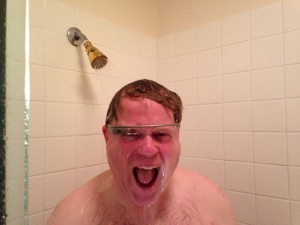
Scoble, a ‘tech evangelist’ whom I met via social media, used to blog for Rackspace on his own blog called, you guessed it, “The Scobelizer”. He interviewed startups, many of whom are already or become customers of Rackspace (possibly so they can be interviewed by Scoble). I say used to, because apparently blogging was too much work for him, so now he just posts on Facebook and Tweets on Twitter (see August 6, 2014 post).
Through this process his personal fame and network continues to grow and is far larger than that of his employers. His Twitter profile for instance @Scobilizer has well over 400,000 followers while his employer @Rackspace in comparison has a measly 81,000 followers.
Yet Rackspace realizes what many other firms don’t. That personal brand equity of any employee, whether the CEO or a tech evangelist is not something to worry about or covet. They also realize that just like any advertising it’s extremely difficult to measure, and has a slow positive drip-like effect, i.e. it is not measured in immediate direct sales alone, but the longtime ROI can be enormous.
Rackspace is laughing all the way to the bank. As potential clients like myself first become aware of Scoble they also become aware of Rackspace and learn that the company happens to also be known for extremely high quality. Rackspace prices aren’t cheap, they match the companies perceived high quality.
Personal brand equity and social media influence are not something to mistrust, nor something to measure in cents and dollars in a simplistic cash flow analysis. It can be, and usually is, cheaper yet far more powerful than any other advertising or PR your firm can pay for.
If your firm is ‘LUCKY’ enough to have someone like this, make sure you value this resource properly, or chances are someone else will…
@TomHCAnderson
@OdinText
@InfoAdvantage
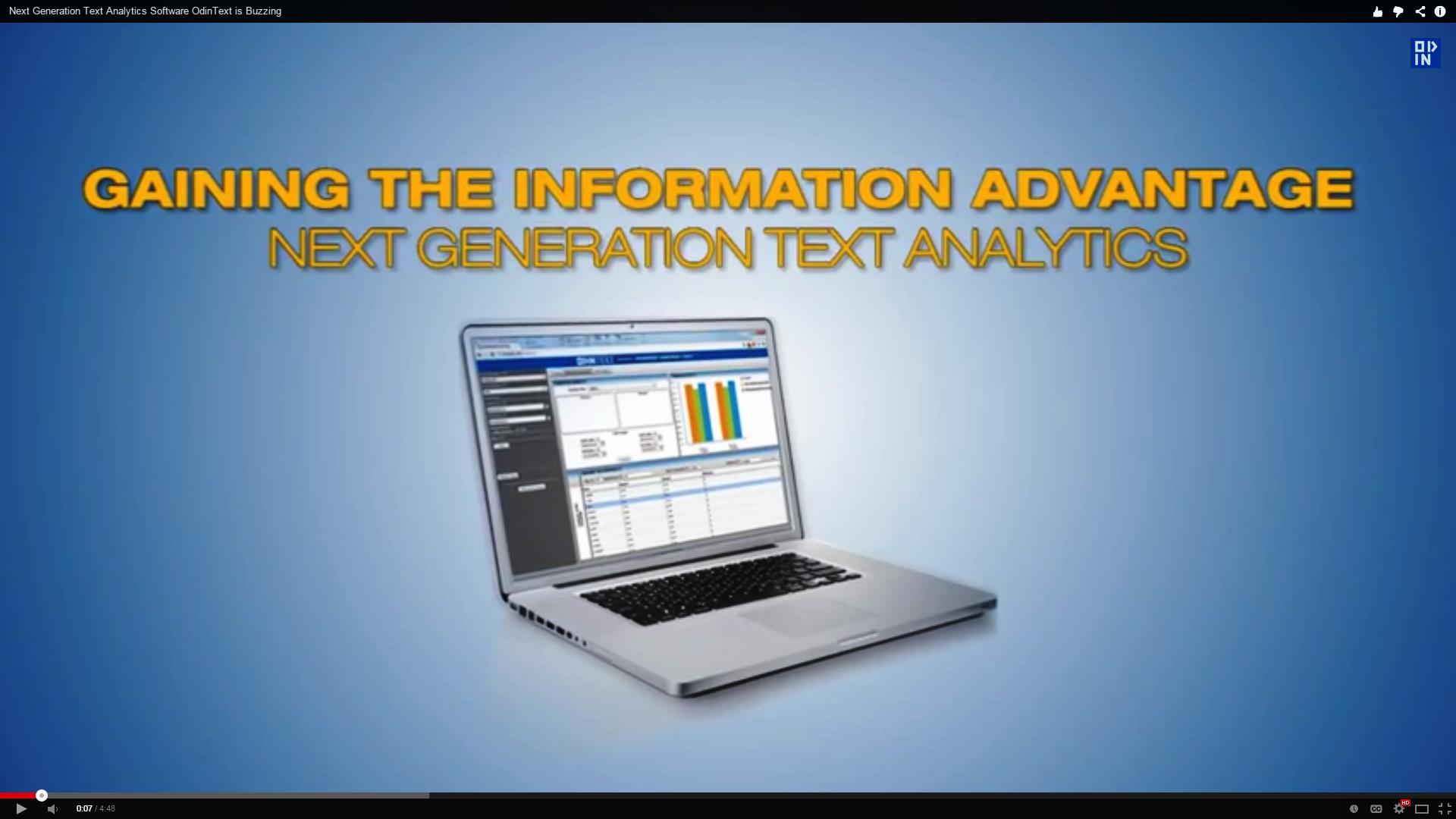
[ NOTE: Tom H. C. Anderson is Founder and CEO of Anderson Analytics, developers of patented Next Generation Text Analytics™ software platform OdinText. For more information and to inquire about software licensing visit ODINTEXT INFO REQUEST ]