



Wondering if true quality has a place in today’s push for cost efficiency through globalization?
A study released yesterday among luxury car brands claimed BMW ranked #1 on quality and Toyota ranked 5th! I don’t think we know what quality is anymore, and perhaps it’s the consumers fault.
Most “economic historical” books that compare life then and now, when discussing the products available today, claim that we now have better products at a cheaper price than ever before in history.
I thought I was too young to experience nostalgia, but I’m beginning to think that somewhere in the last 7-15 years, quality as we used to know it disappeared.
I think perhaps it began to happen in the late 80’s/early 90’s. First, Americans thought Japan was taking over, not just the global auto market, but all markets. Japanese investors bought up US real-estate, and we thought we’d all be eating rice very soon. I think quality made a little comeback then. But then the East and Southeast Asian economic crisis of the mid 90’s gave us the false reassurance we were looking for. It had all been a fluke. See! America was better…
But then again, perhaps in reality we lost it well before the 80’s?
In any case, I posted about a bad experience I had at the BMW dealer on my blog recently and this has made me think about quality, more recently about Volvo. Volvo, like Saab, was originally a Swedish brand, recently purchased by US companies Ford and GM. Volvo used to have a High Mileage Club. You could join the club after 100K miles. For each 100K miles you got another badge. I’ve seen several Volvos with well over 5 badges in Sweden - No Joke. There are Volvos that have well over 10 badges, one at least that has gone well over 2 million miles (see image at bottom of post). Now that’s standing behind your product!

The motto Volvo used to have for their club went something like “It’s a pretty popular club, considering you have to drive 100,000 miles to get there” and “VOLVO FOR LIFE… A Volvo can last your lifetime and many others after you…”.
I don’t think this is a major push by Volvo anymore. While I’m not sure products are purposely built for obsolescence, our temporal perspective is just so short, especially here in the west. That wasn’t the case originally, with cars like Volvo, Mercedes, etc.
I’m wondering if it will reach Japan as well? I’ll give you an example from Lexus in Greenwich, CT (whom I really like by the way).

I just gave away an LS 400 with nearly 200,000 miles that we had since 1990! Their service department was always excellent and the car really ran well up until the time I gave it away. However, towards the end, even though it ran INCREDIBLY well, my wife had brought it in and had been persuaded to let them run some sort of “safety test”. The list of “safety” fixes they suggested would have cost many times over blue book value, a fact that I pointed out to them. To which Lexus replied, “Yes, perhaps it’s time to buy a new Lexus”. Now I can’t blame them for trying to up-sell me, LOL. However, I rather liked the way Volvo used to treat their customers with older/high mileage autos.
What do you think, is this type of true quality a thing of the past?
- Tom
PS, I’m posting a few shots of the badges and old Volvos below. (We used to have an old Volvo Amazon, these too were amazing!).
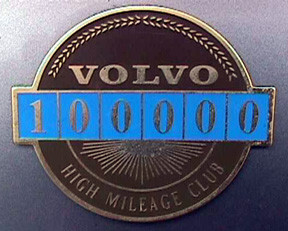
1st level badge
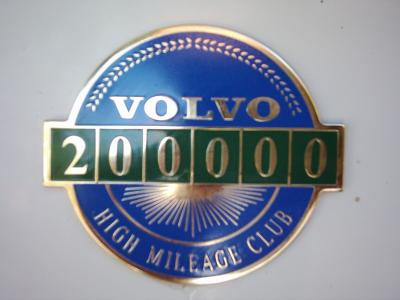
2nd level badge

Volvo with over 2.6 million miles!


13 responses so far ↓
1 Arlene // May 29, 2008 at 6:24 pm
As a Volvo owner and lover for many years, and spouse of a former Volvo employee, I can tell you that the Volvo 240 series, last made in 1993, was also the last of their models built on the rigorous last-for-a-lifetime platform.
.
After that year, they switched to less rigorous platforms and marketed the more “sporty” look.
.
I do not know if they have built (or will ever again build) anything as rigorous as those 240 series models. Best you can now do is look for a used one — if the owner is willing to part with it.
.
My husband and I have two of them, station wagons 1989 and 1993, and we keep them in good maintenance. So far, they are still lasting us fur a lifetime! And, yes, we turn down offers for purchase!
2 Colin // May 29, 2008 at 7:48 pm
I think Walmart + the dollar stores did something to the western world: gave illusion that you are getting more for less….I think it is not priority anymore to have quality, you now have to pay for it vs expect it. Its handled like an option these days. When was the last time wood-grain finish in a luxury car is made of real wood?
If you want quality TODAY, you have to ask for it, it its an option.
You want an entry level car, it is labeled “a cheap car” because of the quality. You want a clone vs a brand name PC and you have to expect you are compromising on quality to get the “better” price.
Quality is here, but expecting it by default…it isnt.
3 induk // May 29, 2008 at 9:01 pm
Quality is where you have your core competencies. Yes, there are many companies who lean their core competencies towards quantities such as Walmart. Although people seeks efficient way to spend their money, but the quality of life is improving daily mainly due to technological advances. Even people who goes to discounted stores try to find better quality product. A product represents the company who produce them. Rather than pushing for the better quality than passing everything onto the customers, it’s time for the companies to increase quality while promoting efficiency in their planning and producing to increase brand loyalty. I think that’s where the niche market is nowadays. When brand loyalty is becoming a thing of the past, you can differentiate your company in quality of the product. Quality product generates residual effects.
4 Pratap // May 30, 2008 at 7:03 am
Consumers today dont make purchases for a lifetime. Its all about meeting today’s requirement and upgrading to newer lifestyles and technology at the earliest opportunity and hence products arent built anymore for a lifetime. Its hard to guess who started this - the consumers or the manufacturers? If marketing is about giving the consumer what he wants i guess we have ourselves to blame for what we get.
Why cars? even clothes are not passed down anymore. The consumer obviously doesnt want to pay for a lifetime quality when he doesnt intend to keep it for a lifetime and hence the manufacturer has to compromise on quality to offer a better price for a lower life expectancy.
The question really is how much are we willing to pay for quality?
5 David K // May 30, 2008 at 11:16 am
Tom,
Thanks for the piece on quality. I too have watched the steady decline of good quality over the years. I am concerned that our younger generations don’t really know what good quality is. Oh the product may be “quality”, but you should remember that there are several different levels of quality.
The flaw in the auto surveys is that they are conducted the second you walk out the door. Well, who doesn’t think they just bought the best car in the world at that point? I don’t think two or three months later makes much of a difference either. I think the surveys should be conducted after the car is turned in from the lease or after 50,000 miles. My guess is there would be very different results. In fact, I have stopped responding to those surveys of “initial quality”. They are just used for the TV ads and now everyone is “number one in the initial quality survey”. I ask the survey companies to please send me a survey in three years. Of course, nobody does.
In business we have a saying that goes something like this: “it takes three things to make a sale; price, service and quality. You can have any two”.
Everyone claims quality; few actually step up and prove it. I guess it is because everything is disposable these days. Even houses are disposable today. How about those million dollar “tear-downs”!
6 Michael // May 31, 2008 at 7:54 am
I think you’re suffering from what every single generation has experienced: nostalgia. The phrase “they don’t make them like they used to” has been used, in one form or another since ancient times. However, as a matter of fact, quality is constantly increasing. Through automation, standards, and careful monitoring of customer feedback, companies are able to respond much more quickly to consumer needs to create the best product at the best price. However, this mass-consumer economy of scale doesn’t come without its drawbacks. Some things will get pushed to the wayside. In a car, certain niceties will be eliminated in order to make the car cheaper to service…car parts become replaceable instead of serviceable; certain options disappear because the company determined that eliminating the feature wouldn’t have an effect on sales.
So it depends what you mean by quality. If by quality you mean getting a car or product that meets your needs, is unlikely to fail, and incorporates thousands of customer needs into the best possible price then your Volvo is likely to fulfill what you would expect in terms of quality. However, if by quality you mean that it is simply over-engineered for long-life, then you’ll of course be disappointed.
However, don’t despair, some carmakers still focus on extreme high quality. Ferrari, Bentley, Bugatti, Lamborghini, and to some extent still Mercedes-Benz. These cars will last for decades, but you’re not going to get them for free.
7 Greg // May 31, 2008 at 1:44 pm
“In fact most products seem to be built for obsolescence. That wasn’t the case with cars like Volvo and Mercedes etc.
Is true quality a thing of the past?”
My 2 cents:
“Built for obsolescence” is a quality. “Built to last” is another quality. “Sporty” is yet another. “Inexpensive” is another. Every item comes with a set of quality attributes.
Generally speaking, the market favors products with attributes people care about. Any of those above will do, so long as the product fulfills the market needs, and does so reliably. A product with a “true quality” of being “budget-priced” can be just as successful as another product that differentiates with “luxurious amenities.” Quality attributes are, in fact, merely points of product differentiation.
So, to answer the primary question “What place does quality have in marketing these days?” - it has EVERYTHING to do with it. If there is not some quality to differentiate a product from another product, what then would be marketed?
There will always be a market niche for products with relatively “high quality” (more features, built to last, well-designed, artful, etc.) There will always be a market niche for products with relatively low quality (disposable, inexpensive, faddish, practical, convenient, or utillitarian.) Pick any value proposition you like - if you don’t market it, nobody will know why they should buy your product.
Now, so far I have spoken about product development, and not branding - that’s another discussion. Brands are, in essence, built on Promises. In order to attain Loyalty, one must first build a relationship. A relationship can only be built if there is Trust. Trust is engendered when expectations are met - thus, Promises (explicit or implied) must be made and kept.
In terms of product development, if an organization is careful about selecting a Brand Promise that can be executed upon, that Brand Promise will dictate the qualities sought in any new product development effforts.
No, quality is not a thing of the past. It will always be with us.
8 Amar // Jun 1, 2008 at 12:10 pm
Quality has many facets. In case of cars it could be long life, better manoueverability, more mileage, safety, luxurious looks, accoutred with navigation system, auto pilot and other ultra modern gadgets, environment friendly etc. If all of these in their best forms were in a single car I am sure only Bill gates would have been able to afford it. Hence, what we have today is segments and the features and the prices in these segments vary as per customer’s requirements and affordability.
Also the consumers are more likely to change rather than drive around in the same vehicle all their life as is the case with mobiles and other lifestyle accessories. This has led to car makers also reinventing themselves with the changing times. Driving today has become faster, more comfirtable, safer and environment friendly and the choice and variety is huge.
Its not that cars that last you a life time are not made these days. There is still a Mercedes, a Bentley but then the prices vary accordingly.
There is something for everyone now. You can take your pick.
9 Ravi // Jun 1, 2008 at 5:39 pm
Tom,
A small example should explain it all..
One does not buy a Merc because it will give you good average but for style or luxury maybe Ferrari could be another example…Someone shopping for luxury cars because of average on gasoline I guess needs to go to Mars !!!
Yes but a honda, toyota or maybe proton could be good examples of quality with luxury and mileage…Completely depends on the choice and the demand on the segment..
I think quality in marketing becomes extremely pivotal to hint at the demand of the product and where does one wants to place the product in the segmentation !
A swatch or an omega will have the same difference…diff quality, style, demand, TA so on..I think some products are aimed with this quality and marketing mix in sync while other are still coping with it !!!
Best
10 Debra // Jun 1, 2008 at 8:28 pm
“Quality” is a relative term, not an absolute that conveys durability, longevity, first rate materials, etc. Quality factors into the Price-Value relationship. I can buy lots of products at low prices that have acceptable quality. And I can purchase products at much higher prices where the acceptable/expected quality level needs to be much higher, more durable, etc.
Quality continues to play a significant role in any marketing program. It should be in sync with the brand equity, or you risk jeopardizing customer satisfaction. Paying a high price and getting an inferior product is a misalignment of quality expectations. Don’t confuse “quality” with “top notch”….it’s a relative term.
11 Peter // Jun 2, 2008 at 8:18 am
I don’t think any product is built for obsolescence. I would argue that most products are over-built and that companies over-deliver on quality, when weighed against the actual needs of the consumer attempting to find a solution to a problem.
and it is, in fact, this obsessive pursuit of Quality with a capital Q that has created the particular social and environmental situation that we’re in.
this is not to say that everyone shouldn’t attempt to try to build a better mouse trap, but it is meant to acknowledge that there is a difference between consumer-relevant quality and the self-referential notions of quality that have been driving growth without addressing the real needs of the consumer in a given behavior.
12 Jason // Jun 6, 2008 at 7:55 am
from the producer’s side, there will always be companies placing quality in the top of their priority, even though the produced product may be out of sync with that. you can market your product as best quality, but as you know, consumers live with the reality and marketing can only go so far. your bmw experience is a good example of that. ask your friends their experience….companies know that’s the best marketing of all.
from consumer’s side, it depends on market segmentation, since each segment has its own tolerance of what “good” quality is. within the context of automobile, roughly speaking expectation of quality would be a skewed bell curve, with highest peak perhaps in the “bmw” class and tapers off at both ends since those markets are less focused on quality.
with stagflation around the corner expect the curve’s shape to widen….
cheers.
13 Edsel Turns 50! (Commemorating a Fatal Consumer Insights Deficit) // Jun 9, 2008 at 7:15 pm
[…] recent post about the lack of quality/service and dismissal of my complaint at the local BMW dealership seemed […]
Leave a Comment