









Influence and Buzz in Marketing Research
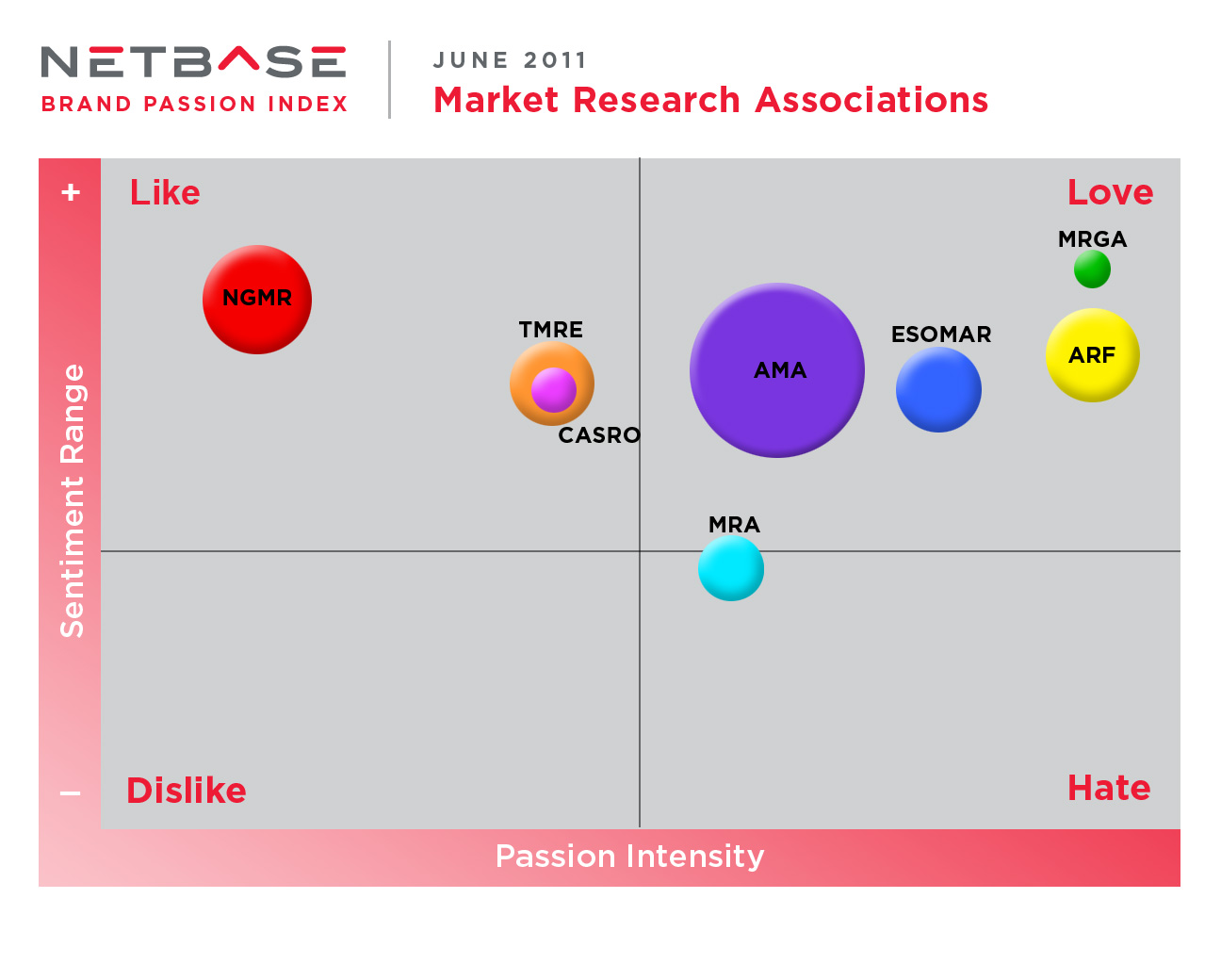
This past week I made the comment on the NGMR LI discussion board that, I’ve been wondering for some time why no one has done any reporting of ‘buzz’ on various online marketing research related domains, and that perhaps I would do something using OdinText but that it would be nice if done by an ‘independent’ firm. NetBase answered the call and sent me the chart above.
Looking at the chart I’m really not sure what to make of it. I’m told by NetBase that this is Online buzz for the past 12 months. I realize everyone’s methodology is slightly different, but while some of this makes sense to me, some things definitely do not.
I suppose I’m not surprised to see MRA (Marketing Research Association) scoring so low on sentiment, after all they seem to have realized it themselves and are currently in a stage of rebranding with a new CEO and new logo etc. However their X-Axis “Passion intensity” makes little sense to me. I know for a fact some of the most interesting and passionate discussions related to marketing research have taken place because of the NGMR group, and yet we are furthest to the left.
Also, I didn’t realize the AMA (American Marketing Association) had so much buzz around them. I know they probably do have largest brick and mortar membership, and have done some interesting stuff lately with virtual conferences and new awards like the 4 under 40 marketing research leadership awards, but it was still surprising to me.
I was also a bit surprised to see IIR’s The Marketing Research Event (TMRE) so large and in the same spot as CASRO on the chart. It is afterall one, well maybe two (Tech Driven Marketing Research) events now.
Curious, if this makes sense to you? Are you passionate about discussing marketing research online, and if so why?
@TomHCAnderson
[NOTE: For a follow up to this post please see NetBase Responds]
![[Post to Twitter]](../../../../wp-content/plugins/tweet-this/icons/tt-twitter-big1.png)


42 responses so far ↓
1 Leonard Murphy // Jun 28, 2011 at 3:44 pm
Interesting that NGMR, TMRE, and MRGA are here at all since they are not associations. Also, what was the time period? I would expect a spike during or right before/after events.
2 Michelle Finzel // Jun 28, 2011 at 3:49 pm
This is interesting, Tom. I would be curious to know how the Sentiment Range and Passion Intensity were rated.
The snapshot may also be biased because the same people may tend to do the most chattering about the same if not similar topics. However, according to what you said, then that would mean NGMR should have been more to the right?
Maybe these scales aren’t clear in what they are represneting - does “like” mean that the buzz likes the topic, or just likes to chat about the topic? I mean, many people don’t like Charlie Sheen right now, but many love to talk about him!
3 Gordon Morris // Jun 28, 2011 at 4:01 pm
Great to see the MRA rebranding, with a new logo and all. Of course, we see branding as the act of sticking a hot piece of metal into the side of a farm animal.
Building a brand is a far deeper, more involved process. I don’t think changing drivers and a respray will cut it for an entity that nobody seems to care about.
4 Tom H C Anderson // Jun 28, 2011 at 4:01 pm
@Lenny I understood that time period was past 12 months. They said these are the 8 ‘domains’ in marketing research that get the most buzz online. True TMRE may not be a trade org, but they certainly look like one online, but yes I too wonder how much of that buzz is just around conference time. In terms of what constitutes an “association”, I guess that depends on how we look at things. Good question though. I’m left with many myself.
5 Gregory (@piplzchoice) // Jun 28, 2011 at 4:01 pm
I would like to understand better what online buzz passion means. In other words what boundaries and qualifiers are applied to the data preceding the sentiment analysis? I have to agree with Tom, that based on my limited personal experience, NGMR members’ conversations and passion seem to deserve better position on the chart - but isn’t that the role of a research to challenge orthodoxies :)?
6 Tom H C Anderson // Jun 28, 2011 at 4:15 pm
@Michelle Yeah, I don’t get it. I refuse to believe NGMR buzz isn’t the most passionate!
7 Meta Brown // Jun 28, 2011 at 4:46 pm
Well, that’s the thing about sentiment analysis. What the definition of passion here? How is it measured? And, as with other types of passion, how do you show it? I imagine most adults are more obviously passionate when expressing dislikes than our likes online.
8 Chris // Jun 28, 2011 at 4:49 pm
I thought a couple of things reading this - It was great to see that the NGMR bubble was quite large. I’ve used this NetBase tool for some industry details and the size of the bubble (amount of chatter) is a good indication why you might find some organizations in odd/unexpected places. MRGA is a good example, great results but only a small amount of chatter so it can be easily swayed (Outliers anyone?). NGMR, ESOMAR, ARF, TMRE and the AMA seem to have good sized bubbles so the analysis is possibly more accurate for those organizations.
9 Bernie Malinoff // Jun 28, 2011 at 4:56 pm
Well Tom, if I had the choice between being “Liked & Differentiated” or “Loved & Undifferentiated” … looks like NGMR is in a class by itself.
10 Seth Grimes // Jun 28, 2011 at 5:04 pm
NGMR is different from all the others in one very significant way:
NGMR is a meme, it’s a concept, a notion. The others are all (merely) organizations, with associated conferences.
I personally use the #NGMR hashtag quite frequently in order to associate things I’m posted with the NGMR meme. My tweets that promote stuff like my text-analytics market survey and the call for papers for my Sentiment Analysis Symposium are pretty dispassionate, but all the same the meme has very significant value for me, value that isn’t captured in a reductionist index.
Seth, http://twitter.com/sethgrimes
11 Kevin Lonnie // Jun 28, 2011 at 5:36 pm
I agree Tom that the passion index for NGMR is surprisingly low, but then again you’re not charging money and that might drive passion. Could you have the NetBase folks send you some of the verbatims? That might help explains things a bit further. - Kevin
12 Tom H C Anderson // Jun 28, 2011 at 6:11 pm
@Seth Thanks
NGMR started as a LinkedIn group. It now has over 12,000 members, many of which have also opted in for news via email. Other than the LinkedIn group we’re on Ning as well here http://www.nextgenmr.com/. On this blog there is a link to two pages one with NGMR members who are on twitter http://www.tomhcanderson.com/next-gen-market-research-twitterati/ and also one with NGMR members who have blogs and carry the NGMR badge http://www.tomhcanderson.com/next-gen-market-research-top-blogs/ . Occasionally we’ll do group virtual events like “NGMR 5 Hot 5 Not” (http://www.tomhcanderson.com/2011/03/09/summary-of-ngmr-top-blogs-5-hot-5-not/) or the NGMR April Fools Blog Event (http://www.tomhcanderson.com/2011/04/05/ngmr-top-bloggers-prove-researchers-have-sense-of-humor/).
Yes we are concluding the Meme competition (http://www.tomhcanderson.com/2011/06/22/ngmr-meme-contest-survey/), and will also be giving out the NGMR Disruptive Innovation Awards again this year, http://www.tomhcanderson.com/2010/11/09/2010-ngmr-disruptive-innovation-winners-announced/ (last year they were given out at TMRE in San Diego 1,000 in attendance). So I like to think of it as a lot more than a meme or twitter hashtag
Several NGMR members have asked contacted me about starting local gatherings, and I’m planning one here in Fairfield County CT.
Many have suggested we should have conferences virtual or real, but that would mean the whole profit thing, and I already have one business to run. Besides, there’s obviously already too much good competition on that front
I like the idea of NGMR being somewhere between a trade org and a conference producer, and keeping the industry honest LOL
13 Tom H C Anderson // Jun 28, 2011 at 6:14 pm
A lot of other things I wonder about when looking at this though. Like why are CASRO and TMRE in the same spot?
Why does no one talk about CASRO online?
Why is the AMA bubble so big?
14 Aaron Burch // Jun 28, 2011 at 6:41 pm
@tom I would definitely come out for the Fairfield County #NGMR meetups if they go down…would bring a lot of the Touchstone Research crew with me as well. Let me know if this comes to fruition.
15 Tom H C Anderson // Jun 28, 2011 at 7:03 pm
Great Aaron
Yes, a couple of us have been planning it. Set two dates already which have been moved. But will get a new one after the Holiday. We want to keep it extremely informal though. Might be either Tigin or CrabShell in Stamford. And we’re going dutch LOL!
I understood there have already been some local NGMR meet-ups elsewhere (Chicago and London).
16 Eric Bell // Jun 28, 2011 at 8:32 pm
It’s easy to say when - your brand is sitting on the most LOVED & PASSIONATE side of things that we are not surprised.
I do feel however that we have an unrivaled strategy in the industry that is very focused on Market Researchers. Our brand is more than about being a trusted or loved organization, it’s about sharing the strategy with EVERYONE, and what most organizations fail to mention that this STRATEGY IS FREE. While there is NOTHING wrong with Paid Membership, Most of our membership is on the FREE Professional Side, we have less than 100 paying clients ALL brands seeking deeper exposure, with over 24,000 FREE Paying Members and a reach to another 174,000 market researchers globally. It’s important to also note that social media strategy and inbound marketing is 100% our key focus globally for Market Researchers. We are trying to build a network that unites FANTASTIC organization outlined including NGMR - we love the work everyone is doing and we are here to help!
We follow a concept called open publishing, that encourages our membership to share, post and debate content globally - then meet virtually and talk about it in every social media format that reaches a professional sphere of influence.
When people say they are surprised by our influence - I invite them to learn more about how we help and keep targeted content focused.
We have an entire dedicated network designed to maximize market research exposure. You are invited to explore them all by simply investing your time to reach out to us and asking for help. We won’t do it all for you, but we will help guide you.
I would also like to invite NGMR, TMRE, CASRO, AMA, MRA, and the ARF to partner with us on MRGA365 to unite the industry on MRGA365 if appropriate.
It think its important not to put to much weight on where everyone falls but rather do the things right that get your impression where it needs to be - we’d love to help.
17 Tom H C Anderson // Jun 28, 2011 at 8:51 pm
@Eric, based on your comment just now I suspect I’m beginning to understand how you’re way off to the right in passion if you use those types of words to describe MRGA everywhere on the web
Above you used “Love” or “loved” three times, once in all caps! You used the word “Passionate” in all caps, you used a lot of all caps actually, you used the word “FREE” in all caps twice, and then “FANTASTIC” in all caps and help followed by exclamation mark.
I could go on… Have you taken a NetBase “Passion SEO class” or something? LOL
18 Reineke Reitsma // Jun 29, 2011 at 3:58 am
Hello Tom,
Interesting graphic.
A thought that came to mind when looking at it is the following: I assume that buzz is based on all the conversations in the public domain, including social networks. In that case it would make sense that organizations that organize more events are more likely to get more buzz (with all the tweets around the event). You also would expect more positive buzz, as you hardly ever see negative event tweets (”Love this #ESOMAR event”, “Attending great track session at #ARF). In the case of for example NGMR, the ‘buzz’ is more content related, and hence more neutral in tone.
Love to hear your thoughts.
19 Tom H C Anderson // Jun 29, 2011 at 6:41 am
@Reineke I’m sure that’s part of it.
I also bet there’s something going on with “Paid” vs. “Earned” media. PR has always known that a more modest word from a respected blogger is worth 10x a flowery paid ad. A lot of ad $ go toward promoting some of these.
20 Katie Delahaye Paine // Jun 29, 2011 at 9:29 am
I want to see the actual data behind this. Are you sure that the AMA you are tracking isn’t the American Medical Association? or some similar acronym?
Also, no offence but in the interest of good research, I’ve never seen a shred of data to prove your theory that a modest word from a respected blogger is worth 10x a flower paid ad so if there is some, I’d love to see it.
21 John Dick // Jun 29, 2011 at 9:32 am
This is the fundamental problem with social media listening as a quantitative tool. All we’re capturing here (and propagating) is a herd mentality. Given that all of the people using these social media tools are doing so without a veil of anonymity, how many people will say anything that alienates them (or their business) from the rest of the crowd. After seeing this chart, what prudent business person is actually going to say out loud “Man, I really hate ARF!?” This is also echoed by @TomAnderson’s point above…who is ever going to live-tweet during a conference session, “This guy sucks!” even though an entire room of people might be thinking it. Most of us can’t help but be influenced by aspiration and peer pressure when we share things that are attributable to us. So what do we really learn here?
22 Tom H C Anderson // Jun 29, 2011 at 10:29 am
@Katie I don’t know. When you evaluate purchasing a brand, product or service, who do you trust more, an advertisement, a blogger who was clearly incentivized to give a shining review in some way, or a more balanced and thoughtful review by a blogger or customer in the review section of say Amazon?
I know where I out more weight.
23 Tom H C Anderson // Jun 29, 2011 at 10:33 am
@John Agree, yet I think that also represents a tremendous opportunity. While not an online publication, this is one of the reasons I value the ‘Inside Research’ newsletter. Because Editor Larry Gold frequently says just that about a speaker or conference. Therefore I am able to trust what he says.
All media is not created equal. In the future I think we’ll need to add some sort of weighting scheme to account for ‘quality of influence’ beyond volume etc. Yet another opportunity for enterprising Next Gen market Researchers
24 Carla Essen // Jun 29, 2011 at 11:00 am
Katie brings up a very good point about the AMA… I use the Netbase tool in the work that I do, and I must caution that that while this data can prove to be valuable, it is truly subjective and directional in nature. AND it is only as good as the search that is structured around it. (To that point, you can (and it would behoove you to) filter out mentions that would relate to the American Medical Association.) The size of the AMA bubble makes perfect sense to me; after all, it is an organization inclusive of all types of marketing efforts - not just research - so naturally the buzz around that would be greater than an organization of a more specialized discipline. The Passion Intensity scale is interesting and one that I have challenged Netbase on many times. As I understand it, those that rank higher on that scale have more mentions with “strong emotion words” - i.e. “adore” or “incredible” as opposed to “decent” or “nice,” for example (and these can be negative emotions too.) What intrigues me most here is the lower placement of MRA in sentiment relative to all of the other organizations - a deeper analysis of the soundbites might reveal why. Interesting topic. Thanks for posting this, Tom!
25 Michaela Mora // Jun 29, 2011 at 12:32 pm
Tom,
This is a perfect example of the need of better and transparent text analytics tools in combination with human judgment (take note for OdinText dev). We all seem to agree that these results are hard to explain. Nobody really knows what they mean. Can you ask Netbase to at least provide the definitions used for the axes and how they arrive to this chart?
26 Eric Bell // Jun 29, 2011 at 2:37 pm
This is all very interesting - I think we should dive in deeper as a team to review where the sentiment is coming from.
We have no SECRET sauce We just like to make our points in a very strategic reachable way. Every point of communication has a plan behind it, even the WORDING behind @mrgasn and social media campaign deployment. Every social media communication should be well thought out and realize it might not be retractable. Every submission gives your global audience the ability to give you a thumbs up or down, a retweet, to a shared link. I wouldn’t worry about so much about what was said, but rather how a reader reacted to it. It’s more about the lineage and legacy a post or comment impacts your readers.
27 Eric Bell // Jun 29, 2011 at 2:38 pm
PS - We are happy to host a virtual lab to work through this with everyone.
Tom do you want to lead? We can invite Netbase to participate as well.
28 Rick Hobbs // Jun 29, 2011 at 3:18 pm
Tom are you not obligated to try to replicate with Odin Text?
29 Tom H C Anderson // Jun 29, 2011 at 5:55 pm
@Michaela Agree completely.
@Rick, in case any social media monitoring tools are listening, let me follow Eric’s lead and start by saying:
NGMR members are AWESOME! OdinText(SM) is the BEST TEXT ANALYTICS software anywhere!!!
Thank you, Now that I’ve tagged this message with self proclaimed and passionate SEO, let me get to your question
I did think about it. Social media data is always biased in some fashion though, unless you expressly quantify the limitation of source which is usually more limited than many appreciate. This is the reason most of our past projects have tended to be deep dives on more carefully scoped out sources of unstructured/text data rather than claiming to incorporate ‘everything’. Add to that the assumed bias here of me evaluating a group including NGMR…, So I’m not sure how our direct participation would add much value in this particular case.
That said, I’ve sent some questions to NetBase and hope they will soon reply. From what I’ve seen so far by looking at this chart and understanding that it is 12 month sample of social media data, undoubtedly blogs and micro blogs mainly (waiting for clarification to share with you) I think I am beginning to see the value of less well scoped out more boiling the social media ocean as a way to get directional insights for quick decision making. So who knows in the near future we may well use OdinText to gain this type of understanding as well. As for this specific case, I’m hoping NetBase will offer some additional information shortly which I will be happy to share with everyone here on the blog.
@Eric, You know I love you man, hope you weren’t offended above ;). And yes, SEO is half the battle, GOOD and TUSTWORTHY content is the other half. My own personal belief is that it’s impossible to be truly successful in social media without knowing how to generate both. This is pretty useful when you’re analyzing it too by the way At some point very soon I believe research will be able to quantify this relationship better than we currently can.
Overall I’ve been very happy to see some of the comments in the NGMR group and here on the blog and look forward to more insights and feedback that will hopefully benefit not just NGMR but the other domains mentioned above as well.
30 Julie Kurd // Jun 30, 2011 at 12:54 am
Hey Tom,
@julie1research loves #ngmr and #tmre. My vote is red and orange circles to upper right.
Julie
31 Quick Picks: Surveys, Social Media & Punditry | GreenBook // Jun 30, 2011 at 5:01 am
[...] Anderson has an interesting post on a recent analysis that Netbase did on brand perceptions of research organizations via social [...]
32 Seth Grimes // Jun 30, 2011 at 8:06 am
To Carla’s point, ‘The Passion Intensity scale is interesting and one that I have challenged Netbase on many times. As I understand it, those that rank higher on that scale have more mentions with “strong emotion words” - i.e. “adore” or “incredible” as opposed to “decent” or “nice,” for example (and these can be negative emotions too.)’
My understanding is that NetBase’s passion index is designed for consumer brands. Do market-research insiders talk about MR organizations and memes using the same language folks do when they talk about Coke or Apple?
33 Part II: NetBase Responds // Jun 30, 2011 at 1:34 pm
[...] ← Snapshot of The Marketing Research Industry [...]
34 Dan Quirk // Jun 30, 2011 at 2:04 pm
Great post!
Like everyone elseI have to say I am perplexed by this chart. It doesn’t reflect what I see and hear in the “real” world. But, I would also say it also doesn’t seem to represent what I see and hear online either.
I agree with Joh Dickn that all this is capturing at best is a herd mentaility, but I would take it a step farther and say it is also capturing only a tiny portion of the herd (online only) — So even if people were fully honest online, you are missing a lot. Especially because it seems that the online audience is skewed to the research vendors.
This reminds me of the phrase “A life lived offline is no life at all!” or a least doesn’t count.
What is most fascinating to me about this post is that even professional researchers don’t seem to know what to make of this — but this is the future of research?
Perhaps someone just needs to do a simple survey
35 Becky Quarles // Jul 1, 2011 at 11:09 am
I couldn’t agree with Dan Quirk more, especially the part about needing to do a simple survey. Charts like this are interesting and a great way to get a conversation going, but they don’t really answer any important questions. First, as has already been noted, comments are not anonymous and, thus, reflect the herd mentality. Second, we don’t know who is talking and, thus, whether we should take their comments seriously. For example, Tom wondered why so few are talking about CASRO. That’s because CASRO is a trade association and membership is limited to CEOs and few other C-level executives (although research company staff can some conferences and seminars). These executives tend to be older than other researchers and spend less time online. This limits the amount of buzz that CASRO can get. But those who talk about CASRO online are likely to be in top management of a research company. So without anonymity, which frees respondents to say what they really think, and demographic breakdowns, these results raise interesting questions, but they don’t resolve them. Sort of like focus groups.
36 Ernst // Jul 4, 2011 at 5:57 am
Interesting to know what language Netbase researched to base the Buzz research on…
Esomar as an example is a mainly European Association with many many different language contributors on the web. So to measure sentiment or even buzz you should be able to measure this globally.. which means in all languages
37 Tom H C Anderson // Jul 4, 2011 at 12:05 pm
Good question, I believe it’s primarily English, but will let Netbase answer. Regardless, it seems that English is the language of most marketing research buzz, and while sentiment might be affected, I think RE total buzz almost everything would still be caught as even if something is written in another language “ESOMAR” would still be used and caught/counted.
38 Tom H C Anderson // Jul 4, 2011 at 12:06 pm
I’ve never heard of an ESOMAR conference that wasn’t held in English, have you?
39 Tom H C Anderson // Jul 5, 2011 at 9:16 am
By the way, for anyone who is late to the party there is a follow up post here http://www.tomhcanderson.com/2011/06/30/part-ii-netbase-responds/ with its own comments thread
40 Patrick Bateman // Jul 6, 2011 at 11:24 am
Funny that the gang at MRB didn’t even show up on this. I guess the parameters for HATED didnt’ go low enough.
41 Tom H C Anderson // Jul 7, 2011 at 8:23 am
@Patrick, good quesiton. I asked about MRB and was told it had too little buzz.
RE Hated though, according to this methodology it would probably be in the same “loved” place as MRGA since what little buzz they have all comes from themselves and is self promotional.
42 Ghosts of Survey Past and Survey Future | GreenBook // Jul 11, 2011 at 5:14 pm
[...] Snapshot of the Marketing Research Industry – NetBase charted the online conversations for the top MR industry associations, and Tom HC Anderson kicked-off a lengthy online discussion about what the findings mean for the industry and for social media research. [...]
Leave a Comment